The Rise of AI Employees: Your New Colleagues for 2026 (And Beyond)
December 19, 2025

The coffee machine conversation has changed. Instead of discussing weekend plans, your colleagues are now comparing notes on their AI teammates: how Eva organized their inbox overnight, or how Sonny generated three viral LinkedIn posts before lunch. What seemed like science fiction two years ago is now Monday morning reality.
By 2026, 89% of senior HR leaders believe AI will fundamentally reshape jobs, and we're not talking about minor tweaks to existing processes. We're witnessing the emergence of genuine digital colleagues: AI employees with distinct personalities, specialized skills, and the ability to work autonomously alongside human teams.
The businesses that understand this shift now will thrive. Those that don't? They'll be playing catch-up while their competitors are already three steps ahead.
The Four Stages of AI Employee Adoption
Most businesses go through predictable phases when integrating AI employees into their workforce. Understanding where you are: and where you're headed: can save months of fumbling in the dark.
Stage 1: Skeptical Automation
Companies start with basic task automation: chatbots that handle FAQ responses or scheduling tools that eliminate calendar tetris. The mindset is still "AI as tool," not "AI as teammate."
Stage 2: Experimental Integration
Forward-thinking teams begin testing AI for more complex work. A marketing manager discovers that AI can draft entire email campaigns. A sales rep realizes AI can qualify leads faster than manual research. Suddenly, the possibilities expand beyond simple automation.
Stage 3: Strategic Collaboration
This is where the magic happens. Organizations stop viewing AI as a replacement threat and start designing hybrid workflows. Human creativity directs AI execution. AI handles data-heavy analysis while humans focus on relationship building and strategic thinking.
Stage 4: Seamless Partnership
The most advanced companies have AI employees fully integrated into their team structure. These digital colleagues have defined roles, access permissions, and collaborative relationships with human staff. The line between "AI task" and "human task" becomes fluid and strategic.

"Generative AI can automate work activities that absorb 60 to 70 percent of employees’ time." — McKinsey & Company (2023), The economic potential of generative AI: The next productivity frontier
The transition isn't just technological: it's cultural. And that's where most businesses stumble.
The Psychology of Digital Collaboration
Here's the uncomfortable truth: resistance to AI employees often stems from fear, not logic. The same manager who embraces project management software suddenly feels threatened when that software gains conversational abilities and starts proactively solving problems.
Understanding this psychological shift is crucial for successful implementation. Research shows that employees who view AI as a collaborative partner (rather than a replacement threat) demonstrate higher engagement, faster adoption rates, and better performance outcomes (Harvard Business Review; Harvard Business School field experiment).
The key is reframing the narrative from "AI will take jobs" to "AI will take tasks." When a social media manager works alongside an AI that generates content ideas, schedules posts, and analyzes engagement patterns, they're not being replaced: they're being elevated to focus on strategy, brand voice, and community building.

Companies that master this psychological transition create what researchers call "augmented teams": groups where human intuition and AI processing power combine to achieve results neither could accomplish alone (Harvard Business Review).
Real-World AI Employee Applications Across Industries
The versatility of AI employees becomes clear when you examine their practical applications across different business functions. Here's how digital colleagues are transforming key areas:
| Business Function | AI Employee Role | Time Saved | Key Benefits |
|---|---|---|---|
| Executive Support | Inbox management, calendar coordination, email drafting | 25-30 hours/month | Improved communication flow, reduced administrative burden |
| Social Media | Content creation, posting schedules, engagement analysis | 20-25 hours/month | Consistent brand presence, data-driven content strategy |
| Content Marketing | Blog writing, SEO optimization, content calendars | 15-20 hours/month | Higher search rankings, consistent publishing schedule |
| Sales Operations | Lead qualification, outreach automation, CRM updates | 18-22 hours/month | Improved conversion rates, better lead nurturing |
| Customer Support | 24/7 response handling, ticket routing, knowledge base updates | 30-35 hours/month | Faster resolution times, improved customer satisfaction |
In a field experiment with 758 consultants at Boston Consulting Group, those using AI completed 12.2% more tasks, 25.1% faster, with over 40% higher quality on certain tasks—evidence that strategic task distribution, not replacement, drives gains (Harvard Business School Working Paper).
Preparing Your Business for AI Employee Integration
Ready to future-proof your business for 2026? Here's your practical checklist for successful AI employee onboarding:
Technical Preparation:
- Audit current software systems for AI integration compatibility
- Establish data security protocols for AI access
- Create role-based permission structures
- Set up performance tracking metrics
Team Preparation:
- Conduct AI literacy training sessions
- Identify early adopters to serve as internal champions
- Design hybrid workflows that leverage both human and AI strengths
- Establish clear communication protocols with AI employees
Strategic Planning:
- Define specific AI employee roles and responsibilities
- Create escalation procedures for complex tasks
- Develop quality control standards
- Plan for continuous learning and adaptation
The businesses that check these boxes before 2026 will have a significant competitive advantage. Those that wait will spend 2026 scrambling to catch up.
"The value of AI lies in your own use cases." — Gartner (2025), Here’s Why the ‘Value of AI’ Lies in Your Own Use Cases
The Marblism Approach to AI Employees
While many companies struggle with complex AI implementation, some platforms are making digital colleague integration surprisingly straightforward. Take Marblism's approach: instead of requiring technical expertise or lengthy setup processes, their AI employees are designed to work like actual teammates from day one. If you’re weighing that against the do-it-yourself agents, see how the managed and self-hosted options compare.
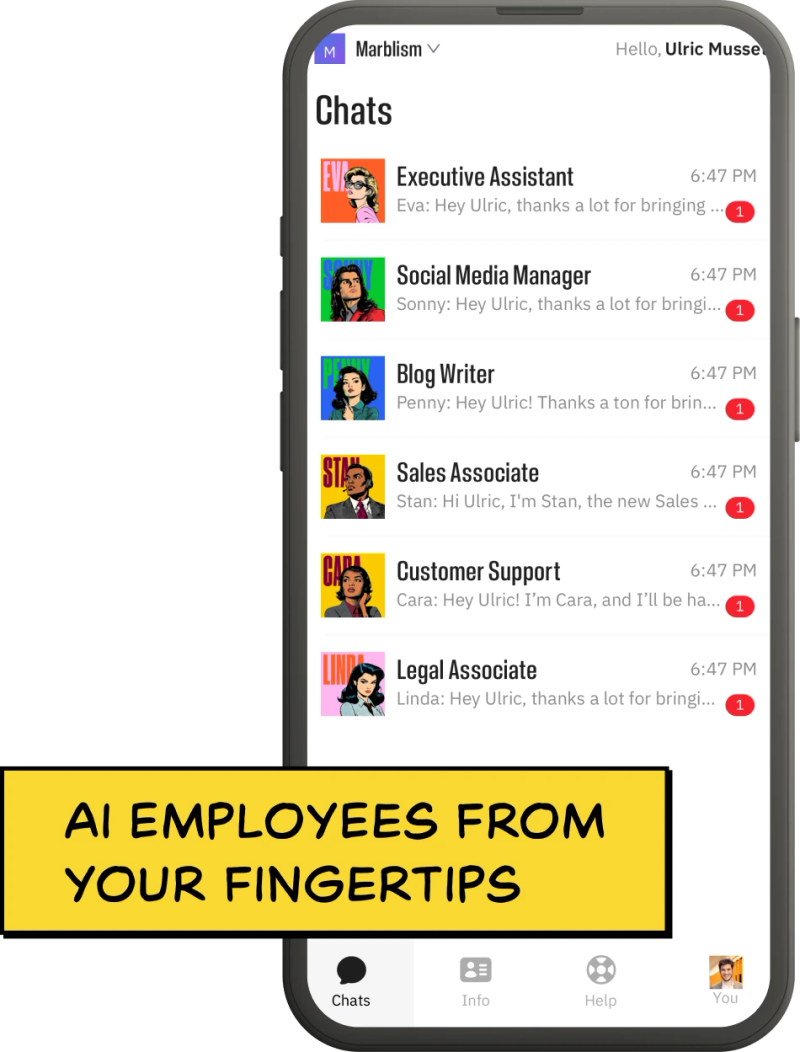
Eva, their AI Executive Assistant, doesn't just process emails: she learns your communication style, understands your priorities, and proactively manages your inbox with the intuition of a seasoned assistant. Sonny, their Social Media Manager, creates platform-specific content that matches your brand voice while staying current with trending topics. Penny, the Blog Writer, produces SEO-optimized content that drives traffic and engagement.
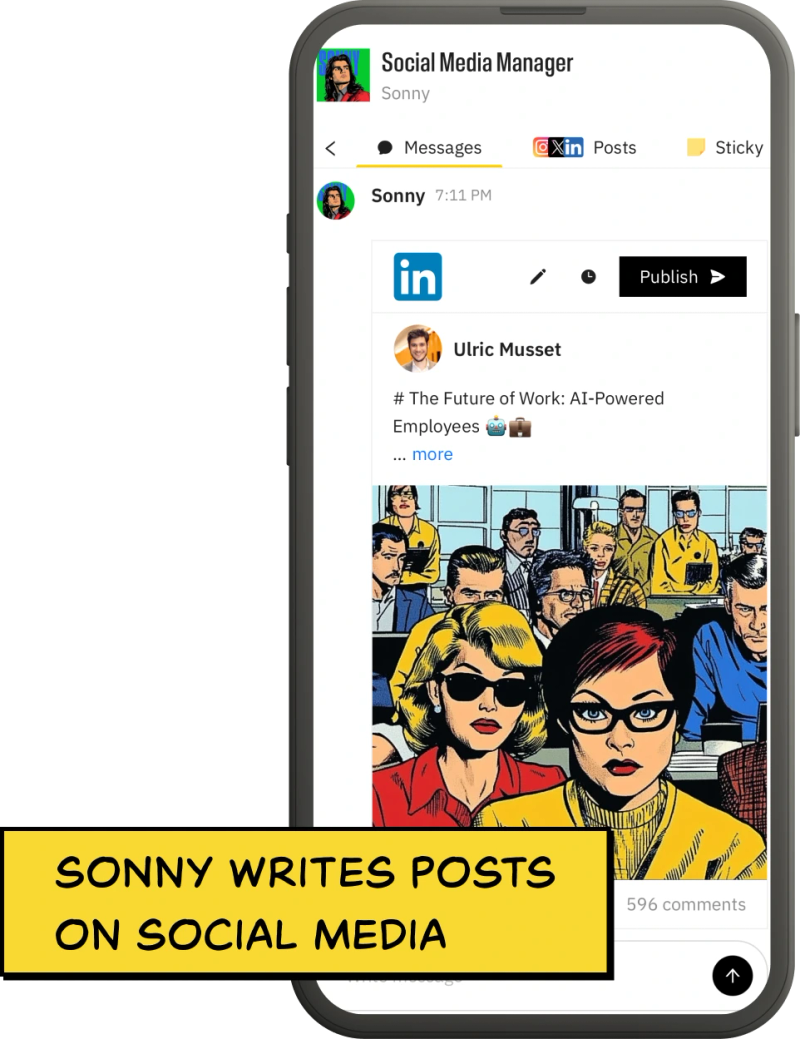
What sets this approach apart is the focus on collaboration rather than automation. These AI employees don't replace human judgment: they amplify it. They handle the time-intensive tasks while humans focus on strategy, creativity, and relationship building.
That division of labor is exactly what Marblism's team of AI employees is built around.
Advanced Implementation Strategies for 2026
As AI employees become more sophisticated, smart businesses are developing advanced strategies to maximize their potential:
Cross-Functional AI Teams: Instead of siloed AI tools, create AI employees that collaborate across departments. Your AI marketing manager should communicate with your AI sales rep to ensure message consistency and lead quality.
Continuous Learning Loops: Implement feedback mechanisms where AI employees learn from both successful outcomes and mistakes. The goal is digital colleagues that become more valuable over time, not just more efficient.
Human-AI Decision Trees: Develop clear protocols for when tasks should be handled by AI, when they require human oversight, and when they need collaborative effort. This prevents both over-reliance on AI and under-utilization of its capabilities.
"Collaborative intelligence: Humans and AI are joining forces." — H. James Wilson and Paul R. Daugherty, Harvard Business Review (2018), Collaborative Intelligence
Performance Integration: Track AI employee contributions alongside human metrics. Measure not just efficiency gains, but quality improvements, consistency enhancements, and creative output. Your AI employees should be held to the same standards as your human staff.
The 2026 Reality Check
Here's what separating winners from losers in 2026: adaptability trumps perfection. The businesses thriving won't be those with the most advanced AI systems: they'll be the ones that learned to collaborate effectively with digital colleagues.
The workplace transformation is happening whether you're ready or not. Manufacturing could see two million workers displaced by AI by 2026, but service businesses that embrace hybrid human-AI teams are experiencing unprecedented growth (McKinsey).
The choice isn't whether to adopt AI employees: it's whether to do it strategically or reactively. Companies that start building these relationships now will have refined, productive digital teams by 2026. Those that wait will be implementing basic automation while their competitors leverage advanced AI collaboration.
Your future colleagues are already here. The question is: when will you introduce yourself?