How Much Does a Virtual Assistant Cost in 2026?

Ulric Musset · CEO, Marblism

A virtual assistant costs roughly $3 to $15 an hour offshore, $19 to $36 an hour in the US, or $1,200 to $3,000 a month for a managed US agency assistant. A full-time in-house executive assistant costs about $5,700 to $9,100 a month once benefits are counted. An AI assistant covers the repeatable slice of that work for a flat $24 to $44 a month.
That sticker range is the easy part. What actually decides whether a virtual assistant saves you money is everything that comes after you hire: the hours you spend directing it, the rework, the turnover, and the months of ramp before it pays for itself. A $5-an-hour assistant who needs constant supervision can cost more per finished task than a $35-an-hour one who runs on their own.
I compared what providers actually charge against surveys of more than 500 virtual assistants, so the figures here come from real data. New to all this? Our guide to what a virtual assistant actually does covers the basics first.
TL;DR
A virtual assistant can run you $5 an hour or $9,000 a month, and both are normal. The label stretches across an offshore freelancer, a US marketplace hire, a managed agency, a full-time executive assistant, and now AI software, so what you pay comes down to which one fits your work and how many hours you need. Keep an eye on the costs the rate hides, though: management time and turnover add more than most owners expect. Work out the loaded monthly cost at your real hours, and be honest about how much of the work is repeatable enough that an AI assistant could take it for a fraction of the price.
| Hiring model | Typical cost | Best for |
|---|---|---|
| Offshore freelance | $3 to $15 an hour | Budget owners with their own systems written down |
| US freelance | $19 to $36 an hour | US hours and native English on project work |
| US managed agency | $1,200 to $3,000 a month part-time | A vetted assistant with none of the hiring work |
| US full-time in-house | $5,700 to $9,100 a month loaded | Dedicated, high-trust strategic support |
| AI assistant | $24 to $44 a month, flat | The repeatable inbox, calendar, and admin work |
Table of contents
What a virtual assistant costs per hour and per month
A virtual assistant costs anywhere from about $3 an hour to more than $80 an hour, or from $450 a month for a part-time offshore freelancer to more than $9,000 a month for a full-time in-house executive assistant. That spread is not vague pricing, it is five genuinely different products sharing one label.
Two independent datasets set the market rate. PayScale, drawing on 394 US profiles, puts the average US virtual assistant's pay at $19.45 an hour, ranging from $12.21 to $29.66. Project Untethered's survey of 147 virtual assistants worldwide found freelancers charge an average of $31.48 an hour, with US VAs at $35.61 and Philippines VAs at $11.33. Layer in provider pricing and a consensus forms: offshore assistants run $3 to $15 an hour, US freelancers $19 to $36, a managed US agency $1,200 to $3,000 a month part-time, and a full-time in-house executive assistant lands around $5,700 to $9,100 a month once benefits are counted.
Those are the numbers to anchor on. The rest of this guide is about picking the right model for your workload, and about the costs that hide behind the rate.
Virtual assistant cost by hiring model
The single biggest factor in what you pay is not experience or task, it is how you hire: direct offshore, a US freelancer, a managed agency, a full-time employee, or software. Here is what each model actually costs and who it fits.
Offshore freelance (Philippines and India): $3 to $15 an hour
Hiring directly in the Philippines, India, or Vietnam is the cheapest route. Project Untethered's survey puts the average Philippines VA rate at $11.33 an hour, and direct-hire freelance rates commonly start around $3 to $8, or $450 to $2,000 a month for full-time work. The trade-off is that you become the recruiter, trainer, and manager: you vet the hire, write the training, cover the timezone gap, and carry the risk if it does not work out. For an owner who already has clear, written processes and mostly needs execution, it is the lowest cash cost available. For one who does not, the savings often evaporate into the hidden costs below.
US freelance: $19 to $36 an hour
A US-based virtual assistant earns an average of $19.45 an hour as an employee, per PayScale, while freelancers charge clients closer to $35.61 an hour on average, per Project Untethered. On a marketplace like Upwork, entry rates start lower, around $10 to $20, with experienced specialists well above $50. You get native English, US-hours overlap, and the flexibility to hire for a project rather than a retainer. You also do the vetting yourself, pay any marketplace fees, and accept that quality varies widely between profiles.
Managed US agency: $1,200 to $3,000 a month
A managed agency does the hiring for you. You pay a monthly rate, typically $1,200 to $3,000 for part-time support, and the agency recruits, vets, trains, and replaces the assistant, and gives you a backup when yours is out. Effective hourly rates land around $30 to $75. Time etc, for example, prices in hour blocks from $390 a month for 10 hours (about $39 an hour) down to $2,160 for 60 hours (about $36 an hour), with no setup fee and unused hours rolling over. You pay a premium over hiring direct, but you skip the recruiting and management overhead entirely.
Full-time in-house assistant: $5,700 to $9,100 a month, loaded
Hiring a full-time in-house assistant means paying a salary plus everything that rides on top of it. Federal wage data puts the median US administrative assistant at $47,540 a year and the median executive assistant at $76,590 a year. But the salary is only about 70 percent of what the employee actually costs you. According to the BLS Employer Costs for Employee Compensation data, benefits make up roughly 30 percent of total compensation, which pushes the true cost to about 1.4 times the wage. That works out to a fully loaded cost of roughly $5,700 a month for an administrative assistant and $9,100 a month for an executive assistant, before you count recruiting or management time. The itemized version is in the ROI section below.
The full comparison, including the AI option
Here are all five models side by side with the same columns, including the AI assistant that has quietly become the cheapest option for repeatable work.
| Model | Typical hourly | Typical monthly | Best for | Watch-out costs |
|---|---|---|---|---|
| Offshore freelance | $3 to $15 | $450 to $2,000 | Budget owners with written systems | You are the trainer and manager; turnover; timezone lag |
| US freelance | $19 to $36 | $1,600 to $4,000 | US-hours project work | Marketplace fees; you do the vetting; quality varies |
| US managed agency | $30 to $75 | $1,200 to $3,000 part-time | A vetted assistant, no hiring work | Premium over direct; possible buyout fees; minimums |
| US full-time in-house | $23 to $37 base | $5,700 to $9,100 loaded | Dedicated, high-trust support | Benefits, payroll, PTO, recruiting, management time |
| AI assistant | Under $1 effective | $24 to $44, flat | Repeatable inbox, calendar, and admin | Handles routine work, not judgment or phone-heavy tasks |
The AI row is not a like-for-like swap for the others, and treating it as one is how people end up disappointed. It is the cheapest way to handle the repeatable slice of assistant work, and no substitute for a human on the judgment-heavy slice. The AI option section below works through exactly where that line sits.
What a VA earns versus what you pay
Before you shop, it helps to know that what a virtual assistant earns and what you pay for one are two different numbers, and the gap explains a lot of pricing. A US virtual assistant earns about $19.45 an hour on average as an employee, per PayScale, but a freelancer charges clients around $35.61 an hour, per Project Untethered, and an agency bills more still. The difference covers the freelancer's own taxes and downtime, or the agency's recruiting, vetting, and margin.
That gap is worth keeping in mind. A rock-bottom rate usually means someone is absorbing a cost you will pay later, in training, turnover, or quality. And the agency premium reads differently once you see it plainly: you are paying $30 to $75 an hour for labor that earns about $19, so the markup buys vetting and replacement, not better work by default. Knowing the spread lets you judge whether a quote is fair or padded.
What affects virtual assistant pricing: location, task, experience, and hours
Within any model, four things move the number. Knowing which one is driving your quote tells you where you can save and where you should not.
Location
Location is the single biggest lever. Project Untethered's survey found US VAs charge roughly three times more than Philippines VAs, $35.61 against $11.33 an hour. Offshore is cheapest on rate; nearshore options in Latin America sit in the middle and buy you timezone overlap with US business hours; US-based is the most expensive and the easiest to coordinate. What you are really buying as the rate climbs is overlap, communication, and lower management effort, not just labor.
| Region | Typical hourly rate | Overlap with US hours |
|---|---|---|
| Offshore (Philippines, India, Vietnam) | $3 to $15 | Little; often an overnight shift |
| Nearshore (Latin America) | $5 to $20 | Strong; shares US business hours |
| US-based | $19 to $80 | Full |
Nearshore rates are less standardized than the offshore and US markets, so confirm them with the specific provider rather than treating the range as fixed.
Task and skill
General administrative tasks, inbox triage, scheduling, data entry, sit at the bottom of the range. Specialized work costs more: bookkeeping, marketing, and executive-level support run $15 to $40 an hour offshore and well above $50 an hour in the US. If you are paying a specialist rate for general admin, you are overpaying; if you are paying a general rate and expecting specialist output, you will be disappointed. Match the rate to the actual work.
| Type of work | Typical hourly rate |
|---|---|
| General admin (inbox, scheduling, data entry) | $3 to $20 |
| Customer support and social media | $10 to $25 |
| Bookkeeping and finance | $15 to $40 |
| Marketing and other specialized work | $25 to $50 and up |
| Executive assistant (US) | $45 to $80 |
Experience
A brand-new assistant charging $5 an hour and a seasoned one charging $25 are not the same purchase. The cheaper hire needs more direction, more checking, and more correction, all of which cost your time. As one operator who talks to owners about VA hiring daily put it, that $2-an-hour rate can balloon to $8 to $16 an hour in real cost once you count the hours spent fixing and re-explaining work. That figure is one operator's estimate, not a study, but the direction matches the research on management time below.
Hours and commitment
Hourly, part-time, and full-time each price differently per hour, and the commitment shape matters as much as the rate. Project Untethered found 57 percent of virtual assistants work 20 hours a week or less, so part-time is the norm, not the exception. Agencies often set part-time minimums; premium services can require multi-month lock-ins and charge a buyout fee if you later hire the assistant directly. A low hourly rate attached to a rigid annual contract can cost more than a higher rate you can cancel any month.
The hidden costs behind the rate
The rate is the visible cost. The one that surprises owners is everything the rate leaves out, so here is the loaded cost of a virtual assistant, itemized and, where possible, backed by research rather than anecdote.
Your own management time
This is the cost owners underestimate most. A hire needs direction, review, and correction, and those hours come out of your week. There is no study isolating the hours spent supervising one virtual assistant, but the research on managing people generally is telling: a Gartner survey of nearly 3,000 employees and managers found that managers spend an average of nine hours a week, more than 20 percent of their working time, on their people. Delegation is not free time, it is traded time. At a founder's effective hourly rate, the hours you spend directing an assistant are a real, uninvoiced line item, heaviest in the first weeks and never zero.
Onboarding and the systems you do not have yet
An assistant amplifies whatever process you already have. If your process lives in your head, the first cost is writing it down, the standard operating procedures you never needed when you did the work yourself. That ramp is real, it lands before the assistant produces value, and it is the reason a hire can feel like more work in month one, not less. One consultant described hiring her first assistant and finding it doubled her workload until she had written her systems down.
Turnover and re-hiring
Cheap assistants churn, and every exit restarts the clock: recruit, train, explain your workflows, again. The cost is larger than most owners expect. Gallup puts the cost of replacing an employee at one-half to two times their annual salary, and calls that a conservative estimate. Recruiting alone averages nearly $4,700 per hire, according to SHRM. A hire who stays and compounds in capability over two years can cost far less than a cheaper one you replace three times in the same period.
Rework, agency markup, and contract terms
Three smaller line items round out the gap. Rework: a rock-bottom rate that produces work you have to redo is not a saving, and the difference between a $4 and a $7 assistant is frequently a different tier of output, not 75 percent more money. Agency markup: on some premium plans, only about 30 percent of the fee reaches the assistant, the rest covering overhead and margin, so it pays to know what the premium buys. Contract terms: minimum hours, multi-month lock-ins, and buyout fees are the most-cited sources of frustration among owners who felt trapped by a premium service.
Is a virtual assistant worth it? The ROI, worked out
A virtual assistant is worth it when the work it takes off your plate is worth more than the loaded cost of the hire. The way to know is to run your own number, not a generic one.
Start with your effective hourly value, what an hour of your time is worth in your business. If you are worth $100 an hour and a virtual assistant removes 10 hours of admin a week, that is $1,000 a week of your time returned, against a loaded cost that might run $1,500 to $2,500 a month for a US assistant. On those numbers the hire pays for itself several times over, provided you actually reinvest the reclaimed hours into higher-value work rather than more admin. The trap is the reverse case: an owner who saves $3 an hour on cheap labor but stays stuck in the weeds because the assistant needs constant supervision has made a bad trade, losing far more in growth than they saved on rate.
Against a full-time employee, the math shifts, and here is where the loaded cost is easy to underestimate. Take the median executive assistant salary of $76,590. Add employer benefits at the BLS figure of roughly 30 percent of total compensation, and the real cost looks like this.
| Cost line (BLS median, 2025) | Administrative assistant | Executive assistant |
|---|---|---|
| Median base salary | $47,540 | $76,590 |
| Employer benefits (about 30% of total, BLS ECEC) | about $20,300 | about $32,700 |
| Fully loaded annual cost | about $67,800 | about $109,300 |
| Roughly per month | about $5,700 | about $9,100 |
The salary line understates the real cost of an in-house hire by roughly a third, and that is before recruiting, equipment, and the management time above. A virtual assistant or a managed service avoids most of that overhead, which is why so many small businesses reach for one first. We compared the two directly in our breakdown of which option saves small businesses more money.
The independent savings figure supports the pattern: Project Untethered's survey found businesses save an average of 66 percent on operating costs by delegating to a virtual assistant. Vendor-published case studies point the same way, though they should be read with their source in mind: one virtual-assistant agency reports that a consumer-electronics startup, Blisstil, saw 15 percent cost savings against hiring in-house and 20-plus hours a week returned to its core team, against a full-time-employee baseline of $60,000 to $80,000 a year. Treat that as a vendor's own account of its client, not independent research, but the direction is consistent across every source here.
When a human virtual assistant is the right call
Before the AI comparison, the honest part: there is a large amount of assistant work that a human should do and software should not touch yet. Pay for a human when the work involves judgment, relationships, or physical presence.
A human wins on phone-heavy and relationship work, the calls where tone and rapport matter, the client a bot would annoy. A human wins on genuine judgment calls, the non-routine decision, the sensitive email that needs reading the room, the one-off project with no template. A human wins on anything physical or local, running an errand, being somewhere, handling a device. And a human wins when the work is varied and unpredictable enough that no process could capture it. If most of your assistant work looks like that, pay for the person and skip the rest of this section. The mistake is paying human rates for work that is none of those things. For the inbox specifically, where the line between the two is closest, we compare them head to head in our breakdown of an AI versus a human assistant on the inbox.
The AI option: what an AI assistant costs versus a human
A growing share of what people hired virtual assistants for, sorting the inbox, drafting routine replies, scheduling, taking meeting notes, is now repeatable enough that an AI assistant can do it at a flat monthly rate a fraction of any human model. The honest framing is not "replace your assistant." It is a task split: hand the repeatable work to software, keep a human for the judgment.
Where AI wins on cost
An AI assistant runs $24 to $44 a month, is available around the clock, starts in minutes rather than weeks, and never churns or needs benefits. Against a $1,500-a-month managed assistant or a $9,000-a-month loaded executive assistant, the cost difference on the repeatable slice is not incremental, it is one to two orders of magnitude. For high-volume, rule-shaped work, email triage, calendar coordination, follow-up drafting, the effective hourly cost falls below a dollar. If you want to compare the tools in this category, our roundup of the best AI executive assistants goes through the leading options.
David Alex, a creator who partners with Marblism, ranks the top AI tools for running a business in 2026 and puts Marblism first on exactly this math: one flat-rate plan standing in for the separate tools and hires most owners stitch together instead.
Where AI does not replace a human
The same honesty the human section demands applies here. AI handles process; it does not yet handle judgment, and pretending otherwise is how people get burned. Three operators who made the switch, each describing their own experience rather than reporting a study, converge on the same lesson. One replaced a $2,100-a-month assistant with about $80 a month of automation, then spent 6 to 8 hours a week on tasks he used to delegate, and concluded that AI handles process better than humans while humans handle judgment better than AI. Another said he had paid $1,400 a month for a VA and could have handled 70 percent of it for about $40 a month in AI tools. Both kept, or wished they had kept, a few hours of a human for the part AI could not do. That task split, automate the routine and keep a human for the rest, is the setup that actually pencils out.
The switcher math
Put concrete numbers on it. An owner paying $1,200 a month for a remote assistant doing mostly inbox, scheduling, and follow-ups is spending $14,400 a year. If three-quarters of that work is repeatable, an AI assistant at $24 to $44 a month covers it for under $530 a year, and the owner keeps a few hours of human help for the judgment-heavy quarter. The saving is real, but only if the honest audit of the work supports it. Run the split before you switch, not after.
Meet Eva
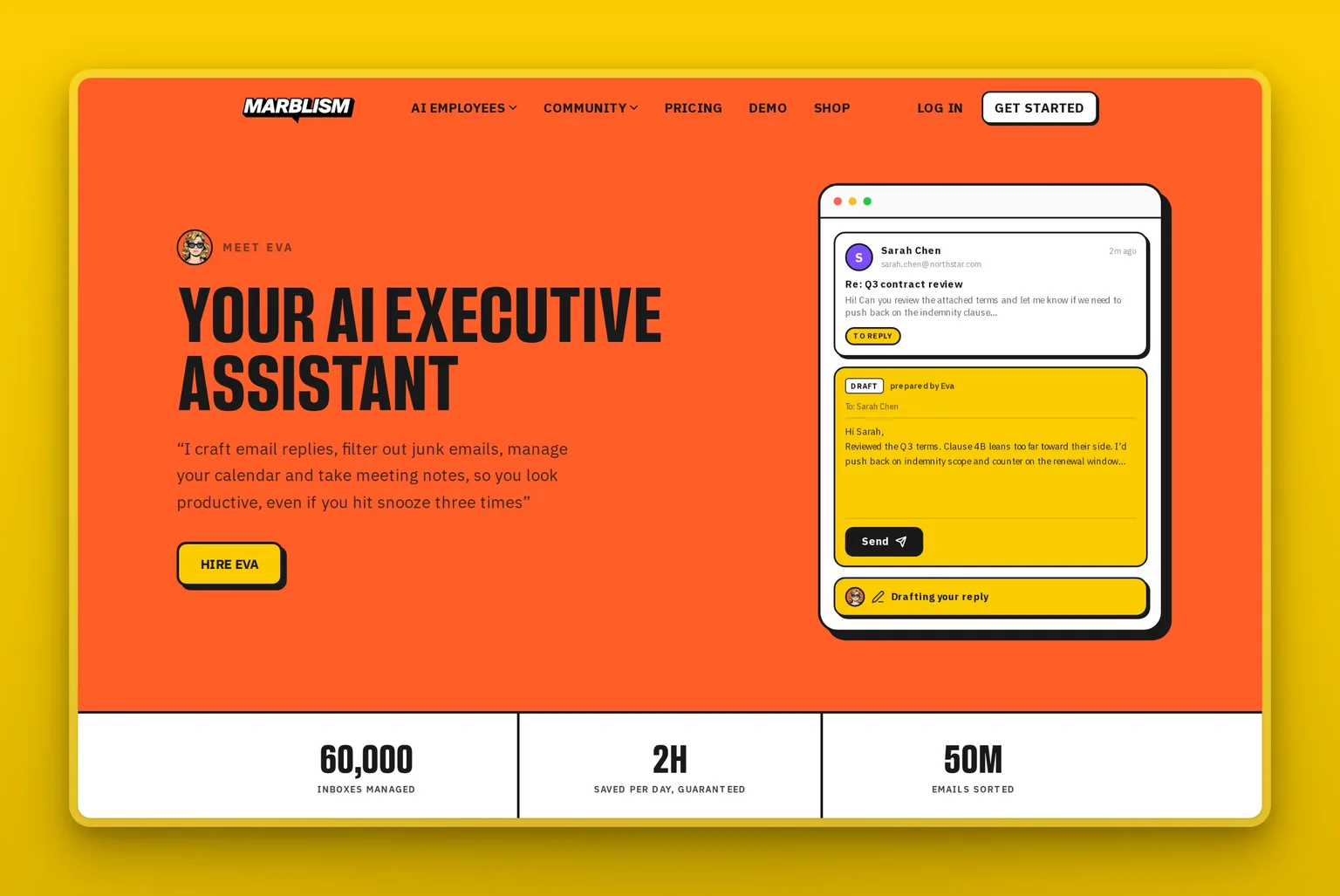
Eva, Marblism's AI executive assistant, is built for exactly that repeatable slice. She organizes and filters your inbox, drafts replies in your voice, schedules and books meetings, and takes notes by joining your calls, working across Gmail, Outlook, or any IMAP inbox. She drafts replies for you to send rather than sending on her own, so you keep control of anything that leaves your name.
She is one of six AI Employees on a single plan from $24 a month, so the same subscription that clears your inbox also covers your calls, leads, social, content, and contracts. For an owner replacing the repeatable slice of a $1,200-a-month assistant, that is the same job for a rounding error on the old bill.
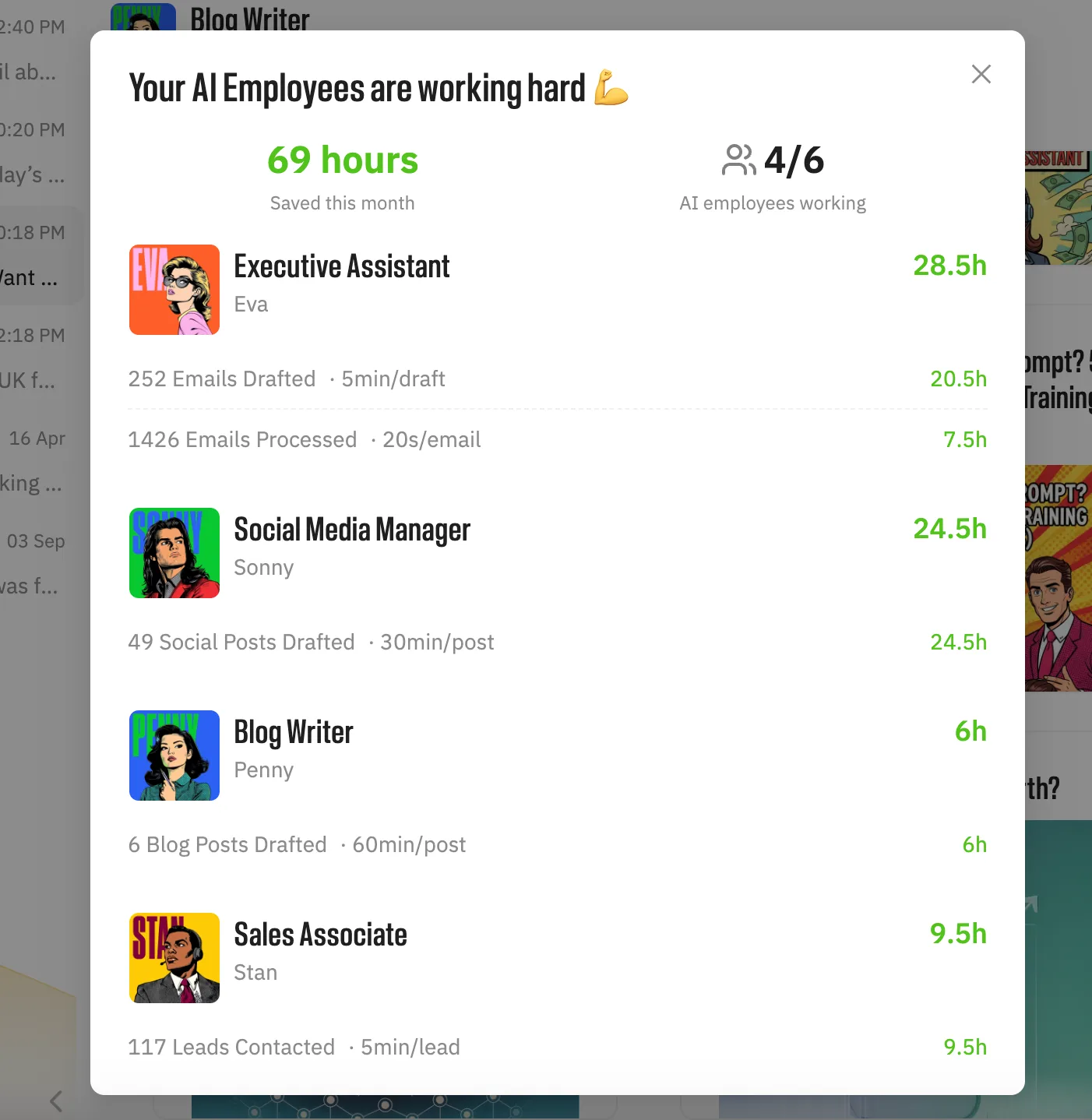
The dashboard above is one owner's month with Eva: the inbox drafted and cleared at a flat monthly rate, the kind of volume a part-time assistant would otherwise have billed for. It is the kind of result behind Marblism's 4.8 out of 5 rating on Trustpilot, where owners keep flagging the same win:
"This AI program has saved me over 40 hrs in the last month alone... Eva helped me clean up my inbox! I had nearly 1000 emails and was losing things til I found Marblism." Crystal Ferragut, from her verified Trustpilot review
Here is Eva handling the kind of inbox work an assistant would otherwise do.
Which model should you choose?
Match the model to your workload and your budget, not to whichever rate looks lowest.
| Your situation | Start with |
|---|---|
| Mostly repeatable inbox, scheduling, and admin | An AI assistant, and keep a human only for the exceptions |
| Tight budget, clear written processes, execution work | Offshore freelance |
| US-hours project work, you can vet candidates | US freelance marketplace |
| Want a vetted assistant with no hiring or management | Managed US agency |
| Need dedicated, high-trust strategic support | Full-time in-house assistant |
For many small-business owners the answer is not one row but two: an AI assistant for the repeatable volume, plus a few hours of a human for the judgment work. That combination usually costs less than a single full-service human hire and covers more of the week. Start with whichever line above sounds most like your situation, and adjust once you see how much of the work is truly recurring.
Frequently asked questions
Cost by model and by hour
How much does a virtual assistant cost per month?
For part-time support, a virtual assistant costs roughly $450 to $2,000 a month offshore and $1,200 to $3,000 a month through a managed US agency. A full-time in-house assistant costs about $5,700 to $9,100 a month once benefits are counted, based on BLS median salaries plus the roughly 30 percent that benefits add. An AI assistant that handles the repeatable inbox, scheduling, and admin work costs a flat $24 to $44 a month. The right figure depends on how many hours you need and how much of the work is routine versus judgment-heavy.
How much should you pay a virtual assistant per hour?
US virtual assistants average $19.45 an hour in employee pay per PayScale, and freelancers charge around $35.61 an hour per Project Untethered's survey. Pay $3 to $15 an hour for offshore administrative help, $19 to $36 for a US assistant, and $30 to $75 an hour through a managed US agency. Specialized work like bookkeeping or marketing costs more. Match the rate to the actual task: paying a specialist rate for general admin is overpaying, and expecting specialist output at a general rate leads to rework.
Are virtual assistants cheaper than hiring an employee?
Usually, yes. A full-time in-house assistant costs not only salary but benefits, which BLS data puts at roughly 30 percent of total compensation, plus payroll tax, equipment, recruiting, and paid time off. That pushes a $76,590 executive-assistant salary to a loaded cost near $109,000 a year. A virtual assistant, whether offshore, freelance, or through an agency, avoids most of that overhead and can be scaled up or down without a hiring or firing process. That lower fixed cost is the main reason small businesses reach for a virtual assistant before an in-house hire.
Is a virtual assistant worth it?
For most small businesses, yes, as long as the work it removes is worth more than its loaded cost. A quick test: multiply the hours it saves you each week by what an hour of your time is worth, then compare that to the monthly cost. If you are worth $100 an hour and it saves you 10 hours a week, that is roughly $4,000 a month of your time returned against a $1,500 to $2,500 bill. It is not worth it when the assistant needs so much supervision that you stay stuck in the same work, or when your tasks are mostly one-off and unpredictable rather than recurring.
How much does a virtual assistant cost in the Philippines?
A Philippines-based virtual assistant charges an average of $11.33 an hour, according to Project Untethered's survey, with direct-hire rates often lower and monthly full-time costs around $450 to $2,000. The rate is low because the cost of living is lower, not because the work is. The trade-off is a timezone gap and the fact that hiring direct makes you the recruiter, trainer, and manager. Owners with clear written processes get the most value from this model.
How many hours a month do most people use a virtual assistant for?
Most virtual assistant work is part-time. Project Untethered's survey found 57 percent of virtual assistants work 20 hours a week or less, and many small businesses start around 10 to 20 hours a month for inbox, scheduling, and admin, then scale up as they find more to delegate. Full-time support is roughly 160 hours a month, though usable hours are lower once you account for breaks and ramp. Start with the smallest block that covers your recurring tasks, then add hours only when you consistently run out.
Hidden costs and contracts
Why did my cheap virtual assistant end up costing more than a pricier one?
Because the hourly rate is only part of the cost. A cheap assistant who needs constant direction, produces work you have to redo, and leaves after a few months costs you management time, rework, and repeated onboarding, none of which show on the invoice. Gallup puts the cost of replacing an employee at one-half to two times their annual salary, so churn alone can dwarf the rate difference. A more experienced assistant at a higher rate who works independently and stays often costs less per finished task.
Are there minimum hours or contracts with a virtual assistant?
Often, especially with agencies and premium services. Many set part-time minimums, some require multi-month commitments, and a few charge a buyout fee if you later hire the assistant directly. Freelance marketplaces and month-to-month AI tools are the most flexible. Before you sign, confirm the minimum hours, the cancellation terms, whether unused hours roll over, and any fee for ending the arrangement early, because a low rate on a rigid contract can cost more than a higher, cancellable one.
AI versus a human assistant
Is an AI assistant cheaper than a human virtual assistant?
For the repeatable slice of the work, dramatically. An AI assistant runs $24 to $44 a month against $1,200 to $9,000 for the human models, and it handles inbox triage, scheduling, follow-up drafting, and note-taking around the clock. What it does not do is replace human judgment on sensitive, complex, or relationship-heavy work. Operators who have switched report replacing 70 to 85 percent of a VA's workload with AI while keeping a few hours of a human for the rest. The setup that saves the most money is usually that split, rather than paying human rates for machine-appropriate work.