What Is an AI Executive Assistant? (Complete Guide)

Ulric Musset · CEO, Marblism

An AI executive assistant is software that runs the routine side of executive work for you: triaging your inbox, managing your calendar, booking meetings, and chasing follow-ups. It acts on its own and around the clock instead of waiting for a prompt. It does that for $10 to $200 a month, against $95,000-plus a year for a human EA once benefits and payroll tax are loaded in. The tools range from single-purpose helpers that guard one corner of your week to a single assistant that owns the whole role.
Most founders never get an executive assistant. The median US executive assistant is paid $76,590 a year, per Bureau of Labor Statistics wage figures published on O*NET. Benefits and payroll tax push the real cost past $95,000. That admin lands back on the founder instead: the inbox that is never actually clear, the follow-up that slips and costs a client, the calendar that keeps double-booking.
An AI version of that help now exists, and it is cheap enough to change the math. The label covers wildly different products, though, from a tool that only guards your calendar to one that tries to run the whole role. The real task is matching the type to the job costing you the most time: a calendar-only tool for a scheduling problem, an all-in-one for a whole-role problem. The one-star reviews, not the feature lists, are where a good demo and a tool people actually keep start to look different, and that gap is the tell I trust most.
Short version: match the type to the job
There is no single best AI executive assistant, because the label covers five different types of tool. Begin with whichever of the five tasks, inbox, calendar, meetings, follow-ups, or research, is eating your week, then pick the type built for that job. If the whole week is the problem and there is only you to run it, that points to one assistant that owns the role rather than a stack you assemble yourself.
| The job that hurts | What it feels like | Where to look |
|---|---|---|
| The calendar | Double-bookings, no focus time, days with no plan | A scheduling-first assistant |
| The inbox | Hundreds of unread, replies written at midnight | An inbox-first assistant |
| The open-ended asks | Research, drafts, and one-off work all day | An open-ended AI assistant |
| Cross-app busywork | The same steps across email, CRM, and docs | A cross-app agentic assistant |
| The whole role | Every part of it is on you, at the same time | A role-based AI employee |
Table of contents
What an AI executive assistant is, and is not
An AI executive assistant is software that owns the administrative half of an executive's week: it triages and drafts email, runs the calendar and books meetings, captures notes, and keeps follow-ups from slipping. What marks the category out is autonomy. You hand over a standing job once and stop issuing a fresh instruction every time. Vendors sell the same thing as an AI administrative assistant, an AI admin assistant, or an AI personal assistant; the label moves around, the work does not.
Three very different products get sold under those words, which is where most buyers go wrong. A chatbot responds to a prompt and retains nothing. A general assistant, the one you open in a browser tab, writes and researches capably but never reaches into your calendar or inbox by itself. Only the third type plugs into the systems your work already lives in and changes something there. It moves the meeting, files the note, chases the reply, and escalates whatever needs a person.
Does it reach into your mail, your diary, and your meetings, or does it sit in a separate window you paste things into? And once it has done something, does it report back on its own, or wait to be asked again? Model, interface, and branding matter far less than those two answers: reaching into your systems and acting without being asked are what separate a real AI executive assistant from a chatbot.
What an AI executive assistant actually does
Underneath the marketing, the job breaks into five concrete tasks. A given tool might own one of these tasks or all five, and where it stops is what decides whether it fits you.
Inbox triage and replies
It reads incoming mail, sorts what matters from what does not, summarizes the long threads, and drafts the routine replies in your voice. The strong ones file, label, and archive by rules you set in plain language, then surface the handful of messages that need you. The right setup can get you to inbox zero in about ten minutes a day.
Calendar and scheduling
It books, moves, and protects time. That covers finding a slot that works across time zones, holding focus blocks so your day is not all meetings, and handling the back-and-forth of scheduling a call without a dozen emails. The better tools write straight into your Google or Outlook calendar.
Meeting notes and prep
It pulls a brief before the call, captures notes during it, and turns the conversation into a clean summary with action items afterward. For a week of back-to-back calls, this removes a task you cannot do well while also paying attention.
Follow-ups and tasks
It tracks the commitments that fall out of your inbox and meetings. Then it chases the reply you promised, the document you said you would send, and the person you meant to circle back to. Dropped follow-ups are where deals and goodwill quietly leak, so this is often the highest-value task of the five.
Research and drafting
It absorbs the one-off asks that fit no calendar or inbox: size up a vendor, rough out a proposal, condense a contract, turn a page of notes into a plan. This is the one task a plain chatbot already does well, which is exactly why so many tools stop here and call themselves an assistant.
AI executive assistant vs a chatbot vs an AI scheduler
Three adjacent products get shelved next to AI executive assistants, and the labels blur together. Telling them apart saves you from buying a $10 calendar-only scheduler when your actual bottleneck is an unread inbox.
A chatbot or general AI assistant, the standalone one you open in a browser tab, generates text on demand. Ask it anything and it drafts, researches, and explains. What it does not do at the lower tiers is reach into your inbox or calendar and act. It waits for your prompt, then forgets. An AI executive assistant is defined by the opposite: it connects to your systems and completes the task without being asked each time.
An AI scheduler is a real AI executive assistant, but a single-purpose one. It owns the calendar and nothing else. That is a genuine tool if your bottleneck is scheduling, and the wrong buy if your real problem is the inbox. The most common mistake is picking a calendar tool because it demoed well, then dropping it inside a month because it never touched the job that was hurting.
Is an AI chief of staff the same thing?
"AI chief of staff" is the newest label in this space, and vendors are actively rebadging existing assistants toward it. The distinction matters, because in humans the two roles really are different jobs. An executive assistant runs the recurring admin: email, calendar, scheduling, notes, follow-ups. A chief of staff owns priorities and judgment: deciding what matters most, planning ahead, and representing the executive in rooms they cannot be in. Career guides draw the line at exactly that point, information management on one side, decisions under ambiguity on the other.
| AI executive assistant | AI chief of staff (as marketed) |
|---|---|
| Runs information management: memory, filtering, tracking, drafting, reminders | Claims judgment under ambiguity: priorities, trade-offs, decisions with incomplete information |
| Inputs and outputs are well defined and repeatable | No single right answer; depends on reading people and unspoken priorities |
| What today's AI does reliably | What today's AI barely does |
Today's AI does the first column well and the second barely at all. Zach Pan reviewed five of the leading agentic "chief of staff" systems and put it plainly: "Every agentic CoS system I studied solves information management: memory, filtering, tracking, drafting, reminders. None of them touch the core CoS function: making judgment calls under ambiguity." In one of the setups he measured, an agent left to act on its own was confidently wrong about once a week.
What matters is whether a "chief of staff" tool does more than the five inbox-and-calendar tasks above, and none of the ones Zach Pan reviewed did. My own read is that the label is mostly repositioning: the same inbox-and-calendar work with a more senior word on the label. If a page promises an AI that sets your strategy, treat it as an AI executive assistant with ambitious marketing until it proves otherwise on the boring, verifiable tasks.
AI executive assistant vs a human EA
Most of the role is repeatable, and that is the share software can carry: triaging mail, holding the calendar, capturing meetings, chasing follow-ups, and putting a first draft in front of you. What software cannot carry is judgment, discretion, and relationships, the parts covered next, whether that means handling a delicate client or ranking two things that are both on fire. One CEO who says she would fire anyone refusing to use AI still keeps a human assistant: the CEO of a software company says AI augments her assistant rather than replacing the role.
One Microsoft 365 columnist asked the new Outlook calendar agent to add two workouts to his week and watched it book both at the same time on Friday. Telling it not to double-book did not help, and it had no way to notice the clash after the fact.
Quality is the other ceiling operators run into: one head of RevOps put it plainly, "AI tools are often only 70 percent good, and that's not good enough. They also need a lot of context to be useful." That is why the approval step matters, and why the safe way in is to let a new assistant draft and book on a short leash before you trust it unwatched.
| Dimension | AI executive assistant | Human executive assistant |
|---|---|---|
| Inbox triage and drafting | Yes, by rules you set | Yes |
| Calendar, scheduling, notes | Yes | Yes |
| Judgment and discretion | No | Yes |
| Relationships, representing you | No | Yes |
| Typical cost | About $10 to $44 a month, single-role to all-in-one | About $76,590+ a year |
| Availability | Around the clock | Business hours |
At $10 to $200 a month against a $95,000-plus human EA, the cost gap is what changes the decision for most owners. A single-role assistant, calendar or inbox only, runs about $10 to $30 a month, an all-in-one assistant that owns the whole role runs $20 to $44 depending on billing term, and a cross-app agentic tool climbs to $50 to $200 once real usage lands.
Even stacking three or four single-role tools rarely tops $150 a month, under 3 percent of a human EA's $76,590-plus salary. That salary alone runs over $95,000 once you load in benefits and payroll tax. Even the cheaper route of a virtual assistant adds up once you count the real hourly cost.
For most small-business owners the honest comparison is not AI against a human assistant, because they were never going to make that hire. It is AI against the nothing they have now, doing all the admin themselves.
Five types of AI executive assistant
Once you know the job, the field sorts into five types. Do not shop by brand name like Motion or Lindy before you know which of the five categories your bottleneck falls into.
| Type | Owns | Example tools | Typical price | Fits when |
|---|---|---|---|---|
| Scheduling-first | Calendar, focus time, booking | Motion, Reclaim.ai | Free to $20/mo | Your calendar is the mess |
| Inbox-first | Email triage, summaries, replies | Shortwave, Superhuman | Free to $30/mo | Email is the second job |
| Open-ended assistant | Research, drafting, one-off asks | ChatGPT, Claude | Free to ~$20/mo | You need flexible help all day |
| Cross-app agentic | Cross-app actions across your stack | Lindy, Arahi | ~$50 to $200/mo | The same steps span many apps |
| Role-based AI employee | The whole assistant role, one login | Marblism (Eva), Sintra AI | ~$24 to $97/mo | Every part of it is on you |
Scheduling-first assistants
These own the calendar. Motion auto-builds your day around your tasks and deadlines; Reclaim.ai defends focus time and recurring habits around the meetings you already have. Reach for one when the calendar is your worst problem, and skip it if your real pain is the inbox.
Inbox-first assistants
These work inside your email as a triage layer, summarizing long threads, drafting replies that pick up your tone, and clearing the noise.
Shortwave is the strongest pick for a Gmail or Google Workspace inbox, with a free tier and an $18-a-month Pro plan, but it has no native Microsoft 365 or Exchange connector, only a workaround that routes Outlook mail through a Gmail account first. Superhuman covers both Gmail and Outlook natively at a flat $30 a month, and that premium only pays off if you live in your inbox for hours a day.
Reach for Shortwave on Gmail if you want to try it free first, or Superhuman if you are on Outlook or want the fastest interface money buys. Skip both if your inbox is not the job actually costing you time.
Open-ended AI assistants
A standalone model like ChatGPT or Claude is the cheapest, most flexible helper for the open-ended half of executive work. It is the one type on this list that is not a full AI executive assistant. It waits for your prompt and does not act on your inbox or calendar by itself. It is also the free-or-cheap entry point most owners try before paying for a dedicated calendar or inbox tool. Begin here if you have never paid for an AI tool, then add a calendar or inbox tool for the recurring work it does not touch.
Cross-app agentic assistants
A newer class of agent, such as Lindy or Arahi, runs multi-step work across your inbox, calendar, CRM, and other apps, delegated by chat. They can take a lot off your plate, but the usage-credit meters are where the complaints run sharpest: credits burning on failed loops that only showed a cost after the fact, so price out a heavy month before you commit.
Role-based AI employees
The last type sells you the role, not a task. Instead of you prompting a tool and checking its output, an AI employee takes a function and reports back. Marblism and Sintra AI both sell this way, a roster of named AI staff on one plan rather than a single tool.
The line between this and a cross-app agentic tool is who builds the workflows. Choose an agentic assistant if you want to design and wire the automations yourself. Choose a role-based employee if you would rather it arrive pre-scoped, so your time goes to approving the output instead of building the workflow. This is the fit when no single tool is the answer because everything lands on you at once.
How to choose one: match the job, then stress-test
Choosing well is two moves: match the tool type to your worst job, then stress-test the finalists against four failure modes. Matching alone rules out most of the market, leaving two or three candidates that get stress-tested against the handful of things that decide whether people keep a tool or drop it by month two.
The stress-test comes down to four questions, and each one maps onto a real one-star complaint. If I could only ask one of them, it would be the second: the two catches that stood out most were Reclaim.ai constantly reshuffling a calendar its owner had already tuned, and Lindy burning through a credit budget on failed loops it never surfaced until the bill did.
- Does it finish the job, or hand you a draft? A tool that leaves you to rewrite or re-enter the work by hand has not taken the job off your plate. The real test is completion. One tap, yours or the tool's own, sends the reply, books the slot, or logs the follow-up, rather than dumping a draft you still have to finish.
- Can you keep it on a leash? The Outlook calendar agent that double-booked two workouts could not check its own work after the fact, which is why an approval step matters. Favor a tool that asks before it acts on anything client-facing, and run it read-only for the first week. That single tap of approval still counts as finishing the job.
- Is the price predictable? The angriest reviews are about credit or per-task billing that spikes in a busy month. Flat pricing is easier to trust; if a tool meters its AI, price out a heavy month before you commit.
- Does your data stay yours? It sees your inbox, calendar, and contacts. Give the vendor's security or trust page five minutes before you connect anything. Does it say plainly whether your content trains their models, does it name where your data is stored, and does it mention a data processing agreement at all? Nothing on the page is itself a warning sign.
One assistant for the whole role
Every type above takes one slice of executive work, which leaves you assembling and running the rest: prompting the assistant, then checking whatever it hands back. That works until every one of those jobs comes due on the same Tuesday. The bottleneck stops being any particular task and becomes you: one person, one attention span, four things that all needed answering an hour ago.
Eva is what happens when none of the five types above is enough on its own. Instead of picking one type and living with its edges, Marblism gives you Eva, your AI Executive Assistant: the inbox, the diary, meeting notes, and replies in your voice, running from one dashboard instead of four separate logins.
What a single-purpose tool cannot match is memory across jobs: because Eva works alongside Marblism's other AI Employees instead of in isolation, the context a lead's email built stays attached to them by the time a follow-up call comes around, instead of resetting every time you switch tools. Every plan includes all six AI Employees, starts at $24 a month, and carries a 7-day money-back guarantee.
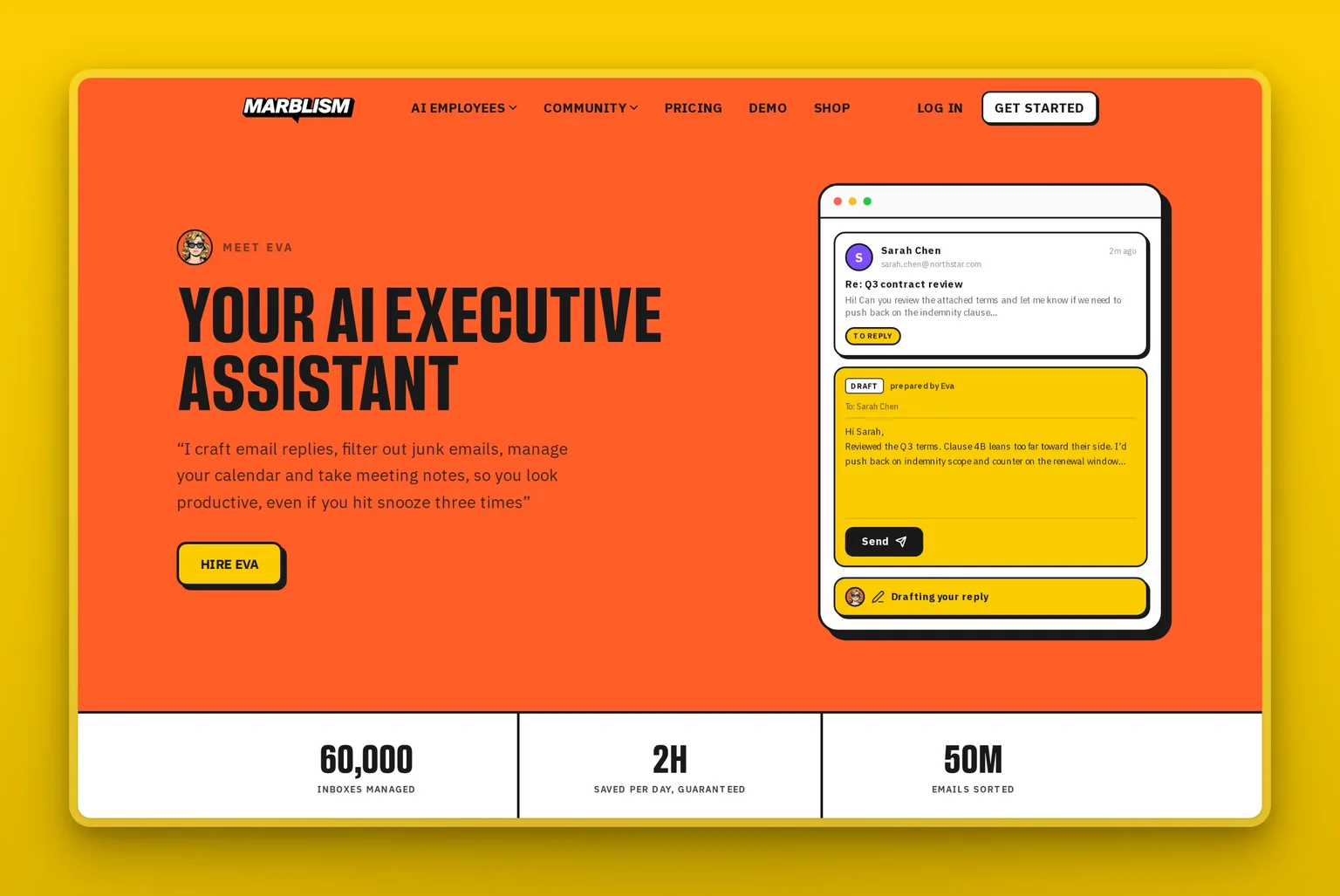
Here is what that looks like on an ordinary morning. A lead emails you a question, buried under thirty other messages. Eva surfaces it, drafts a reply in your voice that answers the question and offers two meeting times, and holds it for you. You skim it, approve it, and Eva sends the reply, books the slot on your calendar, and leaves you a note to follow up after the call. A thread that used to mean stopping what you were doing to write, check, and schedule takes one glance, and nothing left your outbox until you said so.
Marblism is rated 4.8 out of 5 on Trustpilot, and reviewers often describe exactly this kind of inbox relief:
"Marblism is the goat! I don't even think about email anymore… Eva alone is worth the sign-up."
Nadia, Trustpilot review
For the owner whose problem is the whole role rather than one chore, that managed, approve-before-it-sends setup is the best fit. A single-purpose tool is the better buy if controlling each job yourself matters more than handing it off.
How to get started
You do not need all five tool types above; one well-matched tool on your worst job is usually enough to feel hours come back. If I were starting from scratch tomorrow, I would put one job on trial for a month before adding anything else.
Start with whichever job is bleeding the most hours, whether that is the calendar getting reshuffled or the inbox hitting four digits.
- Calendar? Put Reclaim.ai's free tier on it and defend two blocks of deep work this week.
- Meetings? Switch a notetaker on for your next three calls.
- Inbox? Point Shortwave's free tier at one genuinely busy morning and count what it clears.
You grant the tool read and write access to your calendar and inbox, and often your CRM, task app, or team chat. Give it a week or two to learn your patterns before the drafts sound like you.
The work is deciding what it may do on its own and what needs your sign-off. It also means keeping the sent trail somewhere you can see it, so a wrong move is visible and easy to undo.
Add a second tool only once the first month proves the calendar or inbox fixed and a separate bottleneck, like meeting notes, is still costing you time. If all of it is hitting you at once, that is the case for handing the whole role to an AI employee like Eva. Whichever way you go, give what you pick a full month of real work, then ask one thing: did it hand you hours back?
Frequently asked questions
Definitions, tasks, and labels
What is an AI executive assistant?
An AI executive assistant is software that owns the administrative half of an executive's week: triaging and drafting email, running the calendar, booking meetings, capturing notes, and keeping follow-ups from slipping. The stronger products plug into your real mailbox and diary and change things there, then hand back the calls that need judgment.
How is an AI executive assistant different from a chatbot?
A chatbot replies when prompted and remembers nothing afterwards. An AI executive assistant is wired into the systems you actually work in, and it changes them: moving a meeting, filing a note, drafting the response, flagging what needs you. The dividing line is whether it touches your mailbox and diary unprompted, or only talks about them. If it acts solely on request, it is a chatbot, however capable it sounds.
Is an AI personal assistant the same as an executive assistant?
The terms are used interchangeably, and most products marketed either way do the same core work. "AI personal assistant" sometimes leans toward personal errands and reminders, while "AI executive assistant" leans toward professional admin like inbox and calendar. Judge a tool by the tasks it actually completes rather than the label, since the naming is inconsistent across vendors.
Chiefs of staff, schedulers, and humans
How does an AI chief of staff differ from an executive assistant?
In humans, an executive assistant runs the recurring admin while a chief of staff owns priorities and judgment. In AI, that line is blurry, because today's tools do information management well and judgment under ambiguity barely at all. Most products marketed as an AI chief of staff do the same core assistant work as an AI executive assistant, so judge a tool by the jobs it does, not the title on the box.
Is an AI scheduler the same thing as a full executive assistant?
An AI scheduler is a single-purpose AI executive assistant that owns the calendar and nothing else. A full AI executive assistant covers more of the role, adding inbox, notes, and follow-ups. If scheduling is your only bottleneck, a scheduler is the right, cheaper buy; if the whole job is the problem, a scheduler will disappoint because it never touches the rest.
Can AI replace a human executive assistant?
Not fully: it can carry most of the routine load, but a human EA still owns the judgment calls and stakeholder relationships an AI cannot, like deciding which client gets bumped for a same-day meeting. The repeatable share, mail, scheduling, notes, and follow-ups, is what software handles well, at a sliver of a salary. For most small-business owners the honest comparison was never AI against a hire they could not afford anyway. It is AI against doing every bit of the admin yourself.
Cost, security, and choosing
How much does an AI executive assistant cost?
Calendar and inbox tools run $10 to $30 a month, open-ended assistants like ChatGPT Plus are $20, and an all-in-one assistant that owns the whole role runs roughly $20 to $44 a month depending on billing term: it depends on the type. Cross-app agentic tools that act across more of your stack climb higher, often $50 to $200 once real usage lands. Stacking three or four single-role tools instead rarely tops $150 a month, a small fraction of what a human EA costs.
Is there a free AI executive assistant?
Yes, several have a real free tier. Reclaim.ai's Lite plan covers one person, a few inbox tools have a free individual plan, and ChatGPT's free version handles most on-demand asks. Put a free calendar tool next to a free open-ended assistant and you have a working starter setup for nothing, until one job outgrows it. All-in-one assistants lean on a money-back guarantee rather than a permanent free plan.
Is it safe to give an AI assistant access to your inbox and calendar?
It varies by tool, and it matters more here than with most software, because the assistant can see your mail, your diary, and your contacts. Check two things before connecting it. One: does the vendor train models on your content, and is the answer written into a data processing agreement rather than a marketing page? Two: does it act unprompted, or ask first? For anything a client will see, prefer an approval step, so a confident but wrong AI cannot send or book before you have looked.
Is there a single best AI executive assistant?
No, because the right pick depends on the job eating your week. Motion and Reclaim.ai lead for the calendar, inbox tools like Shortwave for email, ChatGPT for open-ended asks, and a role-based AI employee like Marblism's Eva when the whole role is the problem.